There are two statblocks in the Monster Manual that have grievous errors and require correction. One of them is so surprisingly that most people are shocked to learn it, the other is a choice that unnecessarily detracts from the fun.
Cats have darkvision. How on earth did they miss this? Real world cats have the closest thing to darkvision most of us will ever encounter. I’m honestly confused how this hasn’t been changed in an erratum and newer printings. DMs: cats have darkvision. It simply do be like that.
Owlbears are beasts. They are listed as Monstrosities, and the only weak justification appears to be in the last paragraph of its description:
Scholars have long debated the origins of the owlbear. The most common theory is that a demented wizard created the first specimen by crossing a giant owl with a bear. However, venerable elves claim to have known these creatures for thousands of years, and some fey insist that owlbears have always existed in the Feywild.
This “theory” is immediately contradicted by evidence that they are natural creatures.
The ignoble mischaracterization of the owlbear is not just a travesty of natural science, but plain un-fun. Let the druid wild shape into an owlbear! Let speak with animals and beast sense and all the other animalian magic work on owlbears! You can even let a hunter tame one as a companion—it won’t break anything and it’s cool as hell! And—considering how much of the description is dedicated to describing people who tame them—it just makes sense.
I have learned a lot from watching other DMs at work, whether they are folks I’ve gotten to play with at home, or Actual Play DMs on streams or podcasts. Among the latter, I’m most familiar with three: Matt Mercer, Brennan Lee Mulligan, and Aabria Iyengar. They are all very different DMs—though they’ve clearly influenced each other and sure seem to be friends—and run games with very different contextual structures: on Critical Role, Matt runs ~4 hour sessions of very long-form, sandbox campaigns with a table that loves intra-party roleplay; Brennan, on Dimension 20, runs much shorter, sessions of much shorter campaigns where there is a deliberate pace to combat vs roleplay and the set pieces get built ahead of time; Aabria, as a guest DM on these shows, has to be flexible to conform to the production requirements.
TwoThreeFour things that I think are worth noting.
First, when learning from these folks, the “streaming” and “production” contexts are paramount to keep in mind and apply as a lens. Many things they do are applicable in a home game, but not everything.
Second, while CR’s format makes the world feel more open, I don’t think that either Brennan or Aabria are “railroading” their players, at least not any more than someone running a module might. I think this is part of the social contract of play—and one reason why collaborative character creation is so critical—that the players will play characters who are interested in the kind of story hooks the GM will put down. (Which is also a good reason to follow Colville’s advice to start in media res sometimes.)
Third, I’ve only recently come to appreciate the artfulness with which they—but especially Aabria—roll the party’s actions and rolls forward into the story structure and “modularize” the set pieces. During Exandria: Unlimited the Crown Keepers had a nasty habit of rolling like shit on important information, and I thought she was somewhat railroaded by the short format into having to more or less ignore those bad rolls. Watching her run Burrow’s End, however, with the Adventuring Party talkbacks right after each episode, I’m now starting to see beneath her unbelievable GM poker face. To a certain extent, some things are preordained by the production needs. But I am in absolute awe of the way she makes everything feel as if it was the only possible outcome, and bad rolls feel like successes even when they may completely change the story. They’re all good at the three-card monte trick of putting the story in front of wherever the players end up, but while Matt and Brennan tend to make the connection between the roll and the consequence blatant, Aabria can be so much subtler. In awe of the skill.
Finally, nothing is applicable to every table. The D20 crew is almost always open to “so you all go home and sleep and the next day…” while the CR folks like to post watches and have nighttime conversations. Is the former more railroady? In some cases, yes it would be. For that table, though, it’s moving the story along to the next bit that they find fun. (This should be a universal caveat.)
All three of them have certain verbal leitmotifs they rely on. Not the big “how do you want to do this?” moments, and not exactly tics. They’re more like blocks in the foundation of how they run games. Here are a few that I particularly like.
“You can certainly try”
Matt’s favorite response to a hair-brained scheme or shenanigan. This communicates to the players that what they want to do is possible but unlikely to work. It helps set expectations and softly aligns the table that “yes, and”ing this will probably be consequences for the attempt, rather than success. Most of the time, at his table, they try it anyway, and play with whatever happens next.
“For the purposes of this…”
One thing CR has that ExU and D20 don’t is the luxury of playing out goofs that don’t move the story forward—though sometimes they can be powerful character moments. When the players are in a low-pressure scene, or lingering in a goof, they often try to bend the rules. “For the purposes of this” is Matt’s way of letting the players know that he’s making a ruling, almost always to allow something, that shouldn’t be considered as precedent. In a low stakes, fun moment, letting the game get a little goofy by playing loose with the rules can be great. Matt’s table is on board with that and—mostly—seems fine with the inconsistency.
“You see…”
D20, and the longer form Worlds Beyond Number, has the benefit of editing that CR and home games lack. Over time, I think they’ve gotten better at clipping out audible pauses or silence, so it’s less obvious now, but in early D20 seasons, Brennan would often use “you see” as his filler words. “You see,” instead of “um,” not only starts a sentence, but also works almost like a mantra to focus on the PC’s experience. In improv 101, they teach you to just start talking and let your brain catch up. Starting with “you see” prompts the next word: what they see.
“Rad” / “Hell yeah”
Running a game means managing a lot of inputs, especially during combat or other high-paced moments. Your attention can’t be on every player at once—and sometimes you have to take a moment to read your notes or make an adjustment. Brennan will often respond to players with “rad” or “hell yeah,” sometimes automatically, sometimes after what seems to be a very quick evaluation of what they’ve proposed. He’s not bringing his attention back yet, he hasn’t made a ruling—and very occasionally he has had to say “no” once they explain (ahem Emily). In the meantime, he’s encouraging the player to pursue whatever direction they’re talking about.
“I’m going to narrate what happens”
While I think this is mostly applicable for the sort of production-constrained games on D20, it is an effective way to let players know that what’s happening now is out of their control. Players sometimes try to keep taking more and more actions to change some outcome, when that outcome is already the result of their actions. If the result is a bigger story beat or takes a little while to describe, this can gently but explicitly tell the players, in the words of a friend, “let the cutscene happen.”
“What you don’t see”
One of Aabria’s trademark ways of heightening the dramatic tension is very deliberately giving players knowledge that the PCs don’t have. I think this is particularly applicable to home games where our audience is limited to each other. In ExU, she put caps at the end of episodes, presumably without the players, for the audience. When no one else is watching, the only people who can experience dramatic irony are the players—why keep that from them?
For example, I recall one session of a campaign where another PC had taken on a “bad person” persona (it’s complicated and honestly I never fully learned what was up). The player paused at the top of the session to warn us and talk briefly about safety. That meant that I, as the player, knew things about this persona that my PC didn’t. Later, there was a scene with just the two of us. Let me tell you: if you’ve ever yelled at someone in a movie not to open a door, it is so much more intense when you’re also the person opening the door. Here is a trusting, low-Wisdom Wizard and a dangerous, bad person who hasn’t given off bad vibes yet. The way my heart was in my throat while maintaining nonchalant, almost distracted responses: incredible. So, for multiple reasons, I support letting players know things that PCs don’t—at least with the right players.
Part of a series, maybe? In which I reverse-engineer what I’m sure are basics of game design.
A friend of mine recently picked up Blades in the Dark and we are eager to get into some heisty hi-jinks. Heists are hot right now. I just listened to A County Affair from Worlds Beyond Number, which Erika Ishii ran using a heist-modified version of Roll for Shoes. (So there were, you know, two rules.) I even put together a little mini-campaign pitch, inspired by Tiny Heist.
So, incidentally, I’ve been looking at a lot of different systems and thinking about genre, and how those interact.
Heist stories are pure genre, and the major elements are pretty easy to represent in most TTRPG systems. A group of highly skilled individuals with complementary specialties comes together to accomplish a goal contested by a more powerful force. Stakes are high, and ultimately it’s going to come down to out planning and outwitting, with some parts of the plan kept hidden.
Representing Skill
Skill isn’t unique to the heist genre. Robin Hood was an uncanny archer. Anakin Skywalker was a talented pilot. Baby isn’t just a good driver, he’s the best.
When we use dice in TTRPGs to inform the story, we want to adjust the odds to support the fiction. The Rogue should be “better” at picking locks than the other characters, so even though there are dice rolls involved, the Rogue should succeed at that skill more often than other characters would. The Ranger should be able to split the arrow when they want, or at least to have a solid chance, while it would be an amazing random event for everyone else. Like a heist, we want the characters to have unique roles in the story—and we like them to have flaws and weaknesses—so we want to create some kind of skill differential.
d20 systems, like D&D and Pathfinder, and Powered by the Apocalypse (PbtA) use a modifier as the primary mechanism for representing skill. We roll some set of dice and then add to the total. That total is how well a particular attempt went. Each character’s set of modifiers, whether it’s Strength and Intelligence, Charm and Weird, sets them apart. A character with a high modifier may be able to achieve things that other characters simply can’t, no matter how lucky. (“That’s a… 41 for Stealth.”)
Blades in the Dark (BitD), Roll for Shoes (RfS), and World of Darkness (WoD; like Vampire: the Masquerade [VtM]) use dice pools. MI-6’s Q would roll more dice for Tinkering than Bond. Since “plus modifier” isn’t a consistent requirement, there’s more flexibility in how success is determined: BitD uses the highest die rolled; RfS sums up the dice; WoD counts the number of successful dice. Each of those methods produces a different distribution of successes—and requires a different way of representing “difficulty”—but fundamentally a “higher skill” means “more dice.”
Kids on Bikes uses a modifier and the size of the die to represent skill. Evan Kelmp rolls a d4 for Charm, while Sam Black rolls a d20. Since the dice explode, it is possible for Evan to hit a 10 Charm roll, but not likely. For Sam, it’s expected.
Representing Difficulty and Interpreting the Results
There are a few ways systems represent the difficulty and result of a task. d20, RfS, KoB, and WoD require some number to meet or exceed a target set by the GM based on the attempt to succeed, otherwise the character fails. PbtA and BitD use absolute thresholds, where the targets are set ahead of time. The absolute scales allow PbtA and BitD to build in the idea of “mixed success” in a more natural way, but in exchange GMs have limited options to adjust the difficulty of a particular task.
There’s nuance within the “GM sets a target” systems. Among d20 systems, Pathfinder and older D&D editions use something of a sliding scale to adjust the odds to what the DM thinks is appropriate. In D&D 5e and KoB, there is an absolute scale of task difficulty independent of skill. In 5e, a DC 20 skill check is anything that is “hard” to accomplish, not necessarily hard for this character—i.e. a level 11 Rogue may succeed automatically at some hard tasks. In KoB, a 20 is “a task at which only the most incredible could even possibly succeed.”
(Warning: Math) Adjusting the Distribution of Results
How you represent skill and how you determine difficulty and results is one mechanical question. Another is how you want to distribute those results. How much of a different do you want skill to make? Is there a certain type of result you’d like to emphasize, like failure for a “universe is against us” feeling, or mixed for a “actions have consequences” vibe?
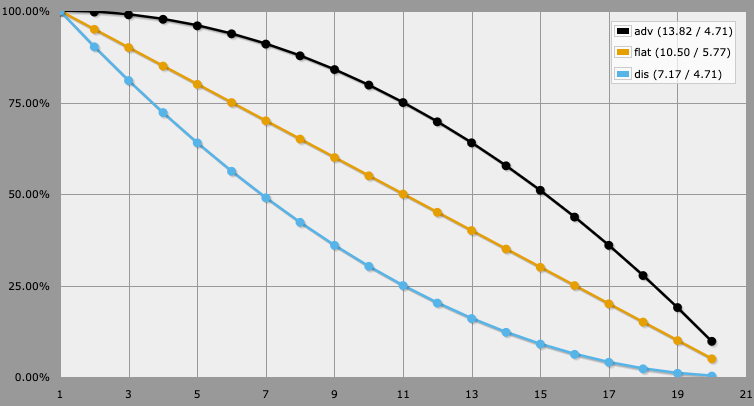
Rolling a d20 has an equal chance of hitting any side. If you need to hit an 11 or higher (with no modifier) that’s 50%. Adding a modifier adjusts the minimum, maximum, and average of the roll, so over time a Wizard with +7 to Arcana should average 17.5 to Arcana checks, instead of 10.5. The probability distribution function for hitting “at least X” has the same shape, shifted left or right.
(Technically this is a graph of P(1d20+m ≥ X), not exactly the probability distribution function [PDF]. But the PDF is hard to see because it’s three overlapping flat lines at 5%.)
So, in d20 systems except 5e we should see that Wizard hit DC 15 Arcana checks more than half the time and DC 20 less than half the time. In 5e, we have advantage and disadvantage which actually do change the distribution of results:
In PbtA, we roll 2d6 plus a modifier. That produces a different distribution (this time as an actual PDF):
And P(2d6 ≥ X) for comparison with the d20 graphs:
This choice pulls the bulk of rolls over time in toward the center—which, in PbtA, means, with modifiers, more rolls will end up landing in and around “mixed success” than full success or failure. PbtA is good at “yes, with a but” storytelling. You can accomplish this, but it will cost you.
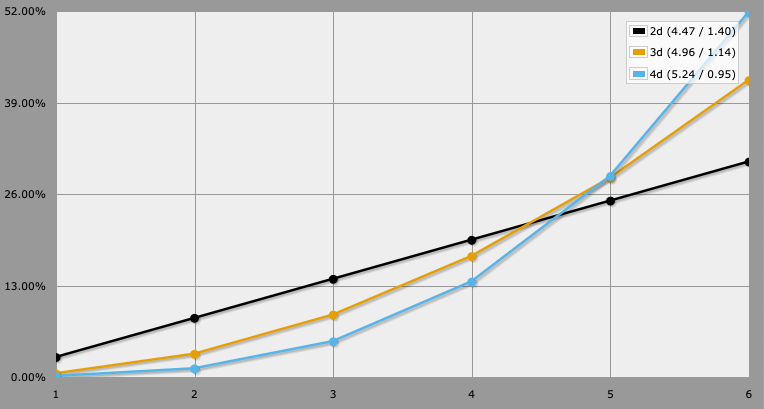
BitD’s “pick the highest of N dice” makes for a very different family of distributions. Combined with using small d6s, skill rapidly increases the odds of getting a great outcome (rolling a 6) and makes a fully bad outcome (rolling a 1–3) increasingly unlikely. (Shown here as PDFs.)
Picking d6s makes great outcomes more likely. If we to adjust the BitD results scale along with the die size, e.g. max is a full success, top half is partial, bottom half is a bad outcome, a few trends appear. The odds of a bad outcome are the same—for 3d, it’s exactly 12.5%, which is the same as flipping 3 coins (3d2) and getting all heads—but the odds of a full success get smaller. For 3d6, the there’s a 42% chance of rolling at least one 6; for 3d8, it’s only a 33% chance of at least one 8; for 3d10, it drops to 27%.
The die size also affects the odds of “critical” successes, e.g. rolling the max number on more than one die. The larger the dice, the rarer the crits.
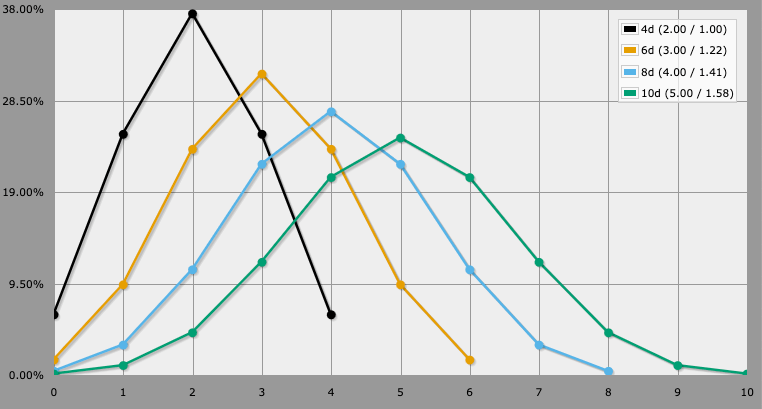
WoD’s mechanism of “count the number of dice that exceed half” produces interesting results where skill makes it possible to succeed at tasks that are too difficult for others by stretching out range of possible results. Here we see the probability density of different numbers of d10s producing X “over 5” rolls:
The die size doesn’t affect this distribution in the same way that, say, adding multiple dice together does—like BitD, it affects the rate of critical successes, i.e. rolling multiple max-value dice. Using d8s instead of d10s would skew rolls toward PCs exceeding their own expectations.
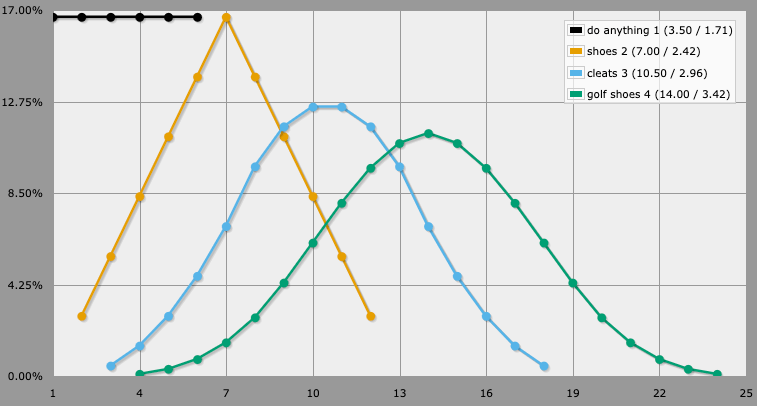
The RfS system of adding multiple dice together combines several of these features. It moves the average, the maximum, and the minimum. Whether in a contested roll or if the GM sets a target, the impact of skill is huge—which is only slightly balanced out by the nicheness of those advanced skills. RfS is truly designed to make things spiral wildly out of control.
So what?
The system of representing skill and success in TTRPGs controls how likely different outcomes are in uncertain situations. We would need to consider other factors like situational adjustments, GM discretion, mechanisms like Inspiration or Heat, etc, to get a full picture. But we can start to see some trends already:
Using a fixed scale like PbtA or BitD shifts the feeling from “how hard is this thing” to “how well do you do it.” It also makes “partial success” easier to manage because it’s fixed.
With “how hard is it” systems, partial success requires adjusting a window around the target. For example, Pathfinder 2e frames this as a “fail DC by 10 or more” threshold for critical failures and “exceed by 10 or more” for critical success, giving us four potential outcomes: crit fail, fail but it could have been worse, succeed but it could have been better, crit success.
If extraordinary success requires hitting the max, bigger dice make extraordinary success less likely, but otherwise they only impact the scale for other numbers, like the outcome thresholds or modifiers. If too much extraordinary success risks making a game too cartoony for the genre, try increasing the die size.
On the other hand, if you want more of those moments, try decreasing the die size.
Adding more dice and picking the highest reduces the odds of failure faster than it improves the odds of success. That makes skill more consistent, meaning fewer moments where the Barbarian rolls a 9 (2 + 7) on a Strength check and the Wizard rolls a 18 (19 – 1).
Summing multiple dice pulls results toward the mean. In a system like PbtA where skill is a modifier and the number of dice are fixed, that can be useful for skewing towards a “mixed” result.
Adding and summing multiple dice also moves that mean and rapidly expands the range of outcomes. This is great for chaos, and maybe out of place in a more serious world.
However, the WoD system of counting dice that meet a threshold has similar properties, with less of a tendency towards the mean and slower growth of the max.
I’m not planning to make a game system any time soon, but I thought this was an interesting set of knobs that can affect story tone. And I needed to write it down to get it out of my head so I can do other things today. 😅
In the Dungeon Master’s Guide. Chapter 8, “Running the Game,” specifically pages 242–245.
Done.
…
Why are you still here?
Okay, okay.
A common-enough critique of D&D 5e is that it focuses most of its rules on Combat. Even if we assume this is true of the Player’s Handbook (which is actually questionable—in the PHB, the Combat chapter is 12 pages, while Equipment is 20; Spellcasting is only 6, but the Spells themselves add another 76, though many spells do deal damage) a question arises about the other two pillars of the game. Where are all the mechanics for Exploration and Roleplay?
In the Adventure modules, usually.
(Spoiler warning beyond this point! Spoilers for Lost Mine of Phandelver.)
In Phandelver part 1: Goblin Arrows, the text includes:
… any character who approaches to make a closer investigation can identify the horses as belonging to Gundren Rockseeker and Sildar Hallwinter.
A little further down (this being intended for completely new players) it continues:
The characters might capture one or more goblins by knocking them unconscious… a captured goblin can be convinced to share what it knows…
Ibid.
That’s a social encounter. Because these are not especially dedicated goblins, there are no published DCs, and the intent appears to be that if the players attempt to ask, cajole, or threaten them at all, you can divulge what they know. A more experienced DM might use the Conversation Reaction tables in the DMG as a basis, and set a DC of something like 10–15 for Charisma (Persuasion or Intimidation) checks.
Still further in the chapter, we read:
About 10 minutes after heading down the trail, a party on the path encounters a hidden snare. … [T]he character in the lead spots the trap automatically if his or her passive Wisdom (Perception) is 12 or higher. Otherwise the character must succeed on a DC 12 Wisdom (Perception) check to notice the trap. … triggers the snare and must succeed on a DC 10 Dexterity saving throw.
Ibid.
That’s an Exploration encounter. This trap is hidden, but not especially well. It’s clear which rolls are required and what the DCs are. I’ve written my own encounters with very similar content.
Going back to the PHB, let’s look at some common adventuring gear. For example, a Lock:
Without the key, a creature proficient with thieves’ tools can pick this lock with a successful DC 15 Dexterity check.
Almost all of the equipment here actually has specific mechanics. Much of it is combat-ish, like the Hunting Trap‘s DC 13 Dex save or the Holy Water‘s 2d6 radiant damage. But there is also a lot of exploration focus: Lamps and Lanterns have specific mechanical light they emit; Manacles have DCs to escape, break, and lockpick them; Tents sleep two (omg they were roommates).
Among Spells, most with casting times or durations over 1 minute—and a handful quicker ones—are explicitly either exploratory or social: arcane eye, augury, charm person, create food and water, friends, minor illusion, etc.
There are three main reasons I can see for both the perception and any reality that the rules are more focused on Combat than on Exploration or Roleplay encounters:
D&D 5e is, at its core, a game about fighting monsters and other baddies. The mechanics, including where the mechanics choose to focus, are designed to help create that fiction: This is a dangerous world and resorting to violence is commonplace.
Combat takes place on the smallest time scale: 6-second Rounds. To navigate such a tight time frame, the rules have to constrain players actions much more.
Combat rules are generalizable in a way—or to an extent—that Exploration and Roleplay rules are not.
I think the last point is particularly interesting. There’s no check needed to convince these goblins to spill their secrets. Later, a goblin leader has a name (Yeemik) along with specific goals and even deceptions. (To be fair, this module continues to be a little light on help for new DMs: it would be helpful to specify that Yeemik should either make make checks or set defined DCs for sneaking and parley.) In Phandalin, there are stated DCs for checks on History and Insight. Outside of town there are specified DCs for Persuasion, Arcana, History, knocking over a statue, Perception, Survival, spotting traps, Religion, Athletics, and lines like: “if they defeat the hobgoblin war band or come to terms with Targor.”
Each of these checks pertains to a specific thing in the world. This hobgoblin can be convinced on a DC 15 Persuasion check. This escarpment requires a DC 12 Athletics check to climb. This fact requires a DC 11 Religion check to recall. This path requires a DC 10 Survival check to follow.
In fact, these rules are generalized in the PHB in chapter 7: Using Ability Scores. The concept of “Bounded Accuracy” is linked to the “Typical Difficulty Classes” table. Thanks to that table we know that knocking over that statue (DC 20) is the hardest thing on the list, technically. We know that some facts are not common knowledge but likely known by any learned person. There’s a lock that is better than average: the DC to unlock it is 20. There is a door in one adventure that says it would, in theory, take a DC 70 Strength check to knock down—a fact included only to underscore the impossibility of the task (spoilers!).
However that’s, more or less, all you can say, in general. The DMG goes a little further in providing tables for DCs to track a creature and DCs for conversational checks based on the disposition of a character towards the party. There are optional Loyalty rules you can use. Xanathar’s Guide fills in some example tables for using artisan’s tools. Tasha’s Cauldron adds examples of things a creature might want to be used in parley. It also includes a list of spells you can use to mechanically describe the effects of certain natural hazards, to help round out some of the exploration.
These are all, though, examples. Starting points. Any individual NPC, trap, hazard, path, or fact, may be more or less difficult to convince, spot, avoid, follow, or know. An NPC in one adventure specifies that “requests made to her succeed with a DC 14 Charisma (Persuasion) [check].” Others in the same chapter—more wary or with less reason to cooperate—require a DC 18 or 19 check to let some information slip. A contingent of downtrodden servants requires only a DC 12 check.
All of the examples are helpful for creating a mental framework for assigning DCs. I think most DMs with more than a single session under their belt have had to improvise DCs as the characters consider something hitherto undreamt. Knowing, for example, that a shopkeeper is on friendly terms with the party but that they are asking for a discount that would put them at a loss, we might set a Persuasion DC at 18 or 20—and make a small withdrawal on their good will on a success. If there are external factors, like with the NPCs above, that may raise or lower it. But then the party decides to Intimidate the shopkeep instead, which needs a DC 25 because even the attempt changes their relationship with the party.
So where are the general rules for Exploration and Roleplay encounters? Spread out, admittedly, across the PHB, DMG, and to a lesser extent XGtE and TCoE.
The specific rules, though, are typically found in the adventures, alongside the specific entity they describe.
Anyone can make a Charisma check—just like anyone can take the Ready or Dash actions—and that’s described in the core rule books. Whether it succeeds or not depends on who they’re talking to. Different creatures have different Armor Classes to hit, and so to do different creatures have different wants, needs, and opinions; different trails receive different levels of upkeep; and different traps are hidden differently.
This dark, jagged blade almost seems knapped from obsidian. A faint wisp of shadow trails from the blade. You gain a +1 bonus to attack and damage rolls made with this magic weapon. When you hit a creature with an attack, it takes an additional 1d6 necrotic damage.
Proficiency with a greatsword allows you to add your proficiency bonus to the attack roll for any attack you make with it.
That’s what’s on the item card. Here’s what in my notes:
This weapon is cursed, and attuning to it extends its curse to you. While cursed, you are unwilling to part with this weapon or end your attunement to it. If you attempt to use any other weapon you must first succeed on a DC 15 Wisdom saving throw. When you draw the weapon, if it isn’t bloodied within one minute, or if you attempt to sheathe it without making an attack, you must make a DC 12 Wisdom saving throw. On a failure, you must move up to your movement and make an attack on the nearest creature to you as a blinding rage takes hold in your mind, after which the rage fades. If you have the Barbarian’s Rage feature and any uses of it remaining, you enter a rage before making this attack. A remove curse spell or similar magic can end the curse on the creature and its attunement to the blade.
This is a pretty good sword! +1 to attack and damage roles and 1d6 necrotic on top of the 2d6 for a greatsword is a pretty solid amount of damage in levels 4–7. Nothing could possibly go wrong here.
The Encounter
As I ran it, the full encounter involved a party member being put to sleep while on watch at night and being kidnapped as a blood magic sacrifice. Nothing out of the ordinary.
The relevant part was that an NPC orc barbarian named Draddok (based on Path of the Totem Warrior with some NPC customization) guarding the bloodbags wielded this sword. Really any angry, strength-based NPC could have it. The party needed to deal with him one way or another to rescue their comrade.
During the fight, the PCs could see shadows in the flickering light cling to the blade. Darkness coalesced around it, leaving almost smokey trails with each swing. Blood seeped into its surface.
The Above-Table Backstory
I loved the visuals of the sword Craven Edge (spoilers) from Critical Role campaign 1. An obsidian blade would be incredibly, almost molecularly sharp and equally brittle, without magic reinforcement. Knapping produces a jagged look, even when the edge is smooth and straight, because of how light reflects off the flaked surfaces.
I prefer to create items that could be used by more than one party member (and sometimes throw in items that are useless to them—it makes sense for a warlock NPC to have a Rod of the Pact Keeper, even if there are no warlocks in the PCs’ party). This party involved a couple of strength-based PCs: a Twilight Domain Cleric and an Oath of Vengeance Paladin. But both typically carried shields. This was the second or third magic weapon I’d introduced at all.
I liked the idea of introducing the choice between the shield and a two-handed weapon, and that the curse was going to reinforce that choice. The blade is eager to fight, to kill. The DC to use another weapon is higher than the DC to control the rage because it wants to be used, and it’s going to be most of the time. But it does want to be used—to sheathe an unbloodied blade is an anathema.
As a higher level item, I probably would have done 2d6 necrotic damage and had the DC to avoid the rage escalate with some kind of reset, like a long rest.
The Lionheart Blade is mostly an uncommon item with a bit of lore that amused me. I did put it into a game—and will again—but I don’t think the PCs or players ever actually found out the story of it. So here, internet strangers, one for you to enjoy.
Lionheart Blade
The pommel and crossguard of this magical rapier are delicately and ornately carved and set with jewels—which are revealed under close inspection to be rhinestones. While wielding this sword you get a +1 bonus to attack and damage rolls.
While holding this sword, you can use a bonus action to gain the effects of the heroism spell, targeting yourself only, for one minute (no concentration required). For the duration, you are immune to being frightened and you gain a number of temporary hit points at the start of each of your turns equal to your Charisma modifier (minimum of 1). Once this property has been used, it cannot be used again until the next dawn.
Proficiency with a rapier allows you to add your proficiency bonus to the attack roll for any attack you make with it.
The Lionheart Blade belonged to famous Halfing stage performer Ham Hewett over a century ago. Ham used it throughout his career playing handsome heroes, swashbuckling scoundrels, and vile villains to packed houses.
Unbeknownst to the fans, and even most of Ham’s costars, he struggled with stage-fright for most of his career. Ham’s pre-show ritual included convincing himself to be brave, visualizing the stage and the limelight as a shield to bolster his self confidence. Over time, this repetition, the earnest adoration of his fans, and the inherent magic of the theater imbued the rapier with a spark of Ham’s bravery and derring-do.
Ham vanished at the height of his popularity. Some speculated that he crossed the sea to find new audiences and stories. Others that knew him better thought his anxieties had finally gotten the better of him, and he’d changed his name and stopped performing. Few knew the truth, which was far more mundane: Ham was felled by bandits (or a dragon, or whatever other end you feel appropriate) on some road your players are traveling.
After his death, the Lionheart Blade may have taken any of a few different paths. It may have been assumed to be a worthless prop, and discarded, or lumped in with his other mundane equipment. If it was recognized as magical, it may still be in use by its current owner. If it crossed the path of a dragon, it is likely that it ended up in a hoard, since it is priceless, glamorous, and useless to its draconic possessor.
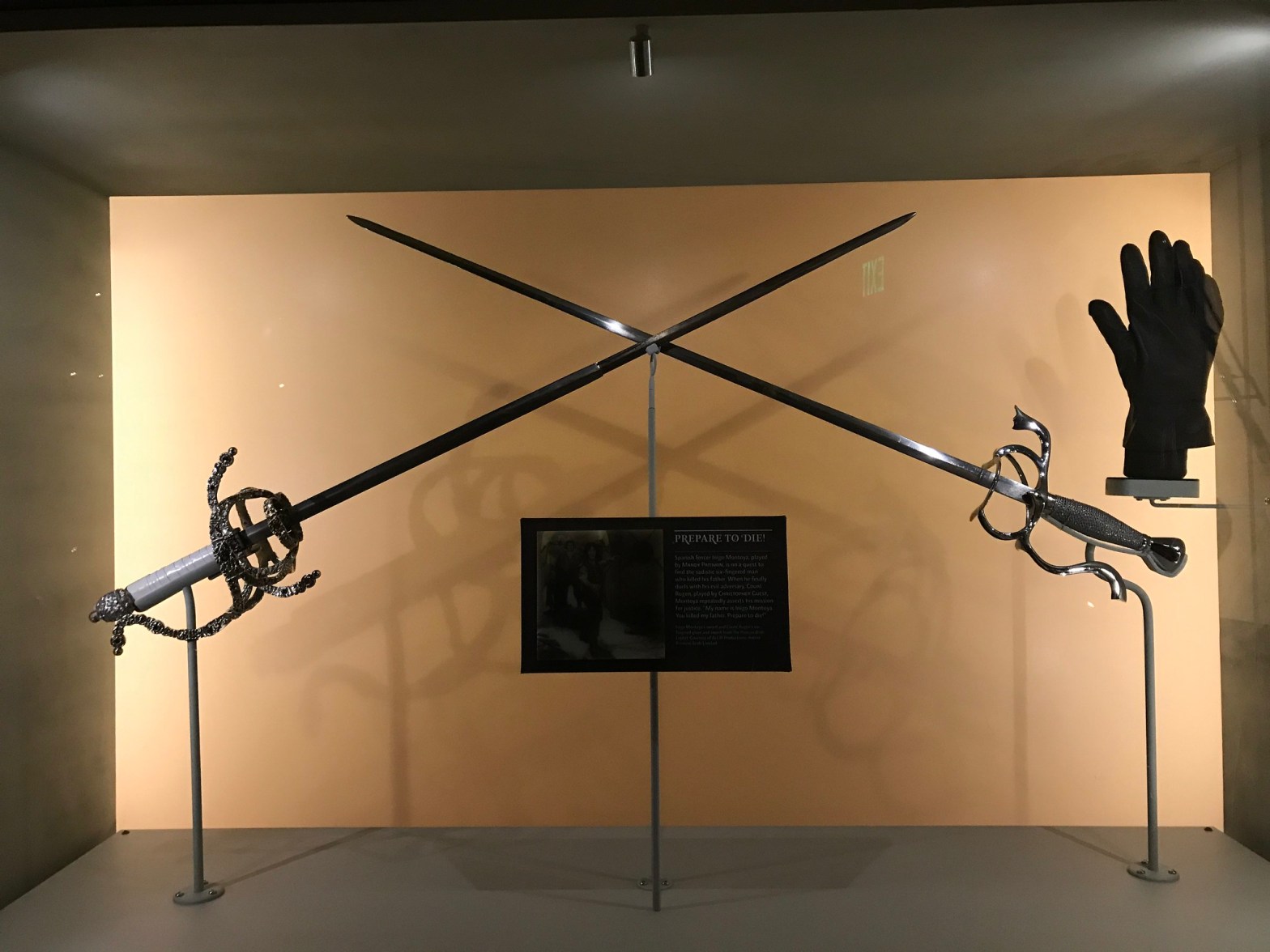
The blade is found with an old, beat-up black leather scabbard with tarnished silvered inlays—it’s well-made, but definitely prioritized looks over longevity. The scabbard could be restored by a skilled artisan, but is not magical. The hilt has an elaborate basket handguard and pommel covered in gems. Think Inigo Montoya’s sword. The first indication that there is something special about this sword is that, despite being cheap costume gems and however old, none of them have dulled or fallen out.
The Above-Table Backstory
The second campaign I joined—and my main gaming group during the early Covid-19 pandemic—was mostly people who worked in theater, including folks who worked with exciting things like pyrotechnics and prop weapons. The theater stories were a consistent background theme to our games and other conversations.
I chose a rapier both for its Errol Flynn/Princess Bride dramatic flare and for the Finesse property. Charisma was the obvious choice for the spellcasting ability. The campaign where I introduced this had a Bard, a Paladin, and a high-Charisma Rogue, and I figured that, despite the heavily bardic flare, there would be some discussion about who should wield it. Sometimes I do create homebrew items with a specific character in mind, but I try to make them more generic and less-obviously-targeted when I can. The world, after all, is much larger than the adventurers, and doesn’t revolve around them.
The Bard had fewer HP and higher Charisma, so the temp HP might be more impactful, while the Paladin was far more likely to use a mêlée weapon. This was also one of the first few (non-cursed, heh) magical weapons I put into the world, so the Rogue would have gotten some utility out of it. Ultimately they gave it to the Bard more or less immediately, and I don’t think ever did much to find out its history. While they definitely stabbed some people with it, I don’t even remember if they ever used the heroism feature.
But then, I didn’t make this thing to be used, really. I made it because it seemed like a neat little story that I told myself—and now all of you.
One house rule that I’ve offered to players in the past, and definitely will again, is a more flexible approach to subclassing, inspired by Pathfinder 2e’s “class feats.” So I thought I would give it a cheeky name: à la classe.
A character à la classe is not limited by a single subclass, but can instead select any subclass feature at the appropriate class levels, as long as:
They meet or exceed the class level “requirement” for that feature. E.g. a level 9 Rogue can take Infiltration Expertise from Assassin or Supreme Sneak from Thief, but not Misdirection from Mastermind, because it is a level 13 Rogue feature.
If a feature B modifies an earlier feature A, you must first take A as a prerequisite. For example, a level 10 Fighter can’t take Improved Combat Superiority from Battle Master unless they have already taken Combat Superiority.
A feature cannot be taken twice. Similar to the rules for Combining Magical Effects, if two subclasses offer the same feature, like the Druid’s Circle Spells or the Cleric’s Potent Spellcasting, you can only take it once.
For the purposes of this house rule, two features with the same name but that are listed twice with different effects must both be taken to get the full benefit. For example choosing the Battle Master’s Improved Combat Superiority at level 10 changes superiority dice to a d10, but does not automatically grant the level 18 Improved Combat Superiority improvement to d12s.
“You included Circle Spells, but don’t different expanded spell lists have different effects?” Good catch! But no, not for our purposes here.
You can only “choose a subclass” once per class. Most subclasses grant more than one feature when you choose the subclass—like the School of Evocation Wizard’s Evocation Savant and Sculpt Spells at level 2, or the Cavalier Fighter’s Bonus Proficiency, Born to the Saddle, and Unwavering Mark. In the class tables, this is the difference between, e.g., a Sorcerous Origin and a Sorcerous Origin Feature.
There are some edge cases and close calls, since the features were not designed with this in mind. For example, the Ancestral Guardian Barbarian’s level 6 feature Spirit Shield improves at levels 10 and 14, and is listed in the subclass table three times. But it is not listed as a separate feature, like “Improved Spirit Shield,” so I would let that improve on its own. (The subclass tables are a useful addition to the subclass layout in newer sources, but they serve more as tables of contents or quick overviews than canonical lists like the class tables and the actual feature headings.)
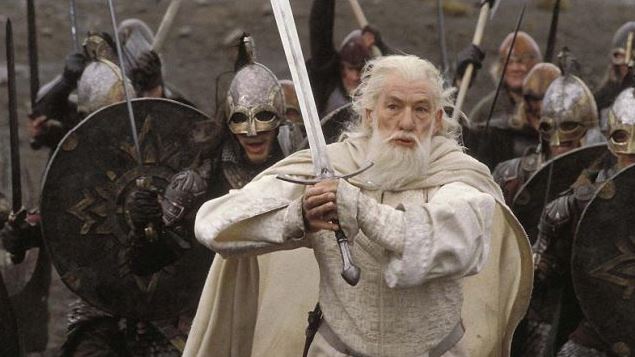
The goal is to open up more mechanical options to help enable the fiction. A James Bond-type Assassin Rogue may want to take the Thief’s Second Story Work over Infiltration Expertise, since that guy is always walking around saying his real name. Or a War Magic Wizard may feel that the Bladesong feature fits their idea of an aggressive, front-line Wizard more closely than the level 10 Durable Magic feature—even Gandalf, after all, does plenty of physical fighting with a sword.
Gandalf—probably a Divination Wizard?—isn’t shy about using his sword, Glamdring.
Since PF2e already does something like this, I feel OK about it from a “balance” standpoint. A player already has to be putting levels into the class to access any of the subclass features, limiting the options for weird power builds (we get it, Gloomstalker Ranger / Assassin Rogue / Battle Master Fighter)—and frankly, players who chase those kind of builds probably won’t enjoy having me as a DM, anyway.
Most classes only get three or four subclass features, so this doesn’t add a ton of flexibility. But along with my own characters that might have used this, I’ve heard enough other players half-jokingly say they wish they could multiclass into the same class for other subclass features. If we can multiclass, why not multisubclass?
What do you think? Is this something you’d allow at your table, or am I missing something that makes this a truly horrible idea?
Content warning: this post is about sex in TTRPGs and how some behaviors closely mirror toxic real-world attitudes toward sex, coercion, and sexual assault. If you found this blog somehow, great, but please prioritize your own safety.
I recently wandered into a discussion on Reddit (so my first mistake) about sex in D&D. Some of the discussion helped refine my ability to talk about it, and I think introduced some folks to some TTRPG safety tools, which is great. But some… was less great. It turns out some tropes are real and have ardent defenders.
Let me start by saying that for me, personally, healthy, consensual sex in TTRPGs is a Veil—I’m ok with it happening in games but it’s a “fade to black” (or “pan to fireplace,” though it turns out that phrase confused some people who aren’t as familiar with post-Code cinema tropes) moment. Sexual assault and sexual violence are a Line. I don’t want them in my games, at my tables; I don’t want to tell or be part of those stories, as a general rule.
(That’s not to say other people couldn’t or shouldn’t tell those stories. With the right group, and expectations, and game system (D&D is not built for this) and with someone else, someone better equipped for this than me, at the helm, I could even imagine trying to be part of a game that explored those themes. But that’s a lot of conditions—and there are more besides—and a big part of it would be answering why this is a story we want to tell.)
Sex is also one of my key session zero topics, because I’ve found it to be a great way to introduce Lines and Veils. It lets me open the floor with a very concrete example. And by establishing that at a minimum, some of these are already in force in this game, I’ve found other people more willing to be the second person to offer some kind of boundary.
My original comment—with the dubious honor of the most interactions any comment of mine has gotten in 10+ years on Reddit—mostly served to underline the thing I replied to, which pointed out that sex is a great session zero topic, and add explicitly that the DM is a player and, as a DM, your comfort counts too. I used the terms Line and Veil (and the “pan to fireplace” thing, whoops).
It generated some reactions and discussion.
One thread just wanted to know what Line and Veil meant, and that’s super fair. Jargon is a Thing, with complex purposes and effects, and I used some of it without explaining. A few other commenters and I shared some info on safety tools, and I hope they help some folks!
A couple of people were confused about the fireplace. One person thought I meant a cooking pan on a fire and was trying to work out the metaphor. Ah, when you’re raised on old films…
Another thread spawned over the idea of “roll to seduce.”
Honestly, I thought this was one of those memes that’s mostly a joke. Oh, har har the bard rolls to seduce the dragon and puerile humor and/or death ensues. But apparently a number of people use this in earnest in their games.
It feels gross to me because it treats sex as something to win, a prize someone may be entitled to. D&D doesn’t have mechanics for this—nor do I want it to. What are you rolling? Deception? Hell no. Persuasion? Straight Charisma to be suave and cool? (If you argue it’s Intimidation then we’re done and I won’t be at the same table as you anymore.)
Consent is something that should be continuously and enthusiastically given. It’s not something you’re on the fence about and get talked into—at least not here, not in this story. Too many people, mostly women, have found themselves on the wrong end of of that in real life.
“Rolling to seduce” (thank you to u/TheJohnarch for helping me phrase this) is one-sided. This is now something that’s happening to an NPC (and, of course, the NPC is still being played by a real human, the DM) because a player decided to. Gross, no.
It is far too close to an all-too-common real world view that sex is owed for winning or doing well enough. That’s what setting a DC on a Charisma check feels like: if you just execute this pick-up artist strategy well, you’ll definitely get laid. It’s a dehumanizing view of how relationships work. It robs people—again, usually women—of their agency. It treats sex as a prize to be won, as something the PC is somehow entitled to.
Some folks objected to the idea of respecting the agency of NPCs. “They’re not real” was one (specious) claim. “They only exist for the PCs to use” was effectively another.
To borrow from Brennan Lee Mulligan, characters—including the characters played by the DM—are translucent. There’s a real person behind these NPCs, because if not, why have a DM at all? The DM shouldn’t be forced to fulfill, nor should other players have to witness, another player’s sexual wish fulfillment. There’s a time and a place and it’s not here. (Though honestly if your table is into erotic D&D with enthusiastic consent from everyone, more power to you).
This is different than other social interactions or encounters and I am ok with that inconsistency.
Because it also, and this nuance may be the source of some pushback, doesn’t necessarily preclude rolling to be flirty or seductive when there’s some other goal you’re after. “I want to try to flirt with the guard and see if she lets some info slip.” “‘Are you sure that’s the best price you can do?’ And I wink.” Those are rolls, you’re trying to accomplish something. (Unless that is a line for someone at the table.) What that looks like and how far it goes depends on the table. (Spoilers CR campaign 2) Fjord’s arc with Avantika, actually using sex to further another goal, is fine for some groups and too far for others. Personally I’d probably stop at flirting.
The absolute nadir of the discussion, to me, was “we want to know what the bard is doing so we go peek in the window.” If sex is a Veil at your table, as it is (at least) at mine, then that, to be absolutely clear, is a deliberate attempt to violate a boundary established by one or more of the players. If someone does that at my table, the session stops, and that person will have an uphill, possibly insurmountable, battle to convince me they should still be welcome.
This comment was, predictably, followed by “it was a joke.” Ah, yes, me the feminist killjoy striking down pure fun yet again. (This is a whole other post but “it was a joke” is the most dismissive bullshit and it never was.)
I was heartened by the fact that many more people seemed to be on the same page—or at least upvoted as if they were—than there were actively defending “roll to seduce.” And I think the thread brought some awareness about safety tools in general, so, I’ll call that a win.
I don’t want to dictate where your table’s Lines and Veils are, or Soft and Hard Limits, or however else you’re taking care of each other. If you want no sex at all, or detailed descriptions—as long as everyone is enthusiastically on board—go for it. But I do want to suggest that you not use mechanics that treat sex as a prize or an entitlement; that you consider whether tropes or jokes in use take a dehumanizing view of sex. And above all, that you talk about it, out of game.
I thought I’d start sharing some of the magic items that I make up, because I love doing it. And some of them have themes or lore that I build them around that doesn’t affect anything so I think it’s OK if a player reads this.
One that I particularly liked is the circlet of grounding, which came with its own introductory little encounter.
Circlet of Grounding
Fine wires of copper and zinc are woven together to form this circlet. While wearing it, you have resistance to lightning damage. When you suffer lightning damage, electric energy empowers you, arcing and sparking around the circlet. While empowered in this way, you can cast the spell shocking grasp (5th level version) as a bonus action. The energy fades after one minute or when you cast the spell.
When you use the circlet to cast the spell, use your spellcasting ability modifier to make the melee spell attack. If you do not have a spellcasting ability modifier, use your Intelligence modifier. You are considered proficient with this attack.
I decided against requiring attunement, for now, because while it’s lightning resist, lightning is 1) not super common, and 2) often used in area-of-effect mechanics. So being a little niche and passing it around will probably be of limited utility.
The Encounter
The circlet is in an old, abandoned laboratory or workshop. The way I described it was like an old science classroom, with 6 tables arranged in a grid. The high-passive-perception monk was the first one in there, and spotted the glint of something metal on the farthest table.
There is one other thing in the room, on a nearby table: what looks like a nearly spherical ball of scrap metal, maybe 18 inches or 2 feet across.
The ball is a long-dormant Bronze Scout. It was left by whoever created this, wherever they went, in a passive defense mode, and it has just been sitting for however long. If anyone in the room makes a lot of noise (I think I set it as a DC 11 or 12 stealth check to avoid, it might have been the Scout’s passive perception at disadvantage) or touches the circlet (the quiet monk immediately picked it up and put it on their head), the scout activates.
The Bronze Scout has one big AOE blast: lightning. There’s a whole theme here.
Of course, the monk’s player is a wonderful agent of action and chaos. I didn’t expect anyone to immediately put it on. I think he thought the circlet might control the Scout. It didn’t, but it did mean he was resistant to its one big attack, so that was kind of amazing.
I was thinking about magic the other day and how I think it works—or at least my default, for settings I run.
Being between books this week, I was re-reading random parts of Rothfuss’ The Kingkiller Chronicles and one of the sections I read was Kvothe’s introduction to sygaldry. In that universe, sygaldry is the name given to a form of magic based on engraving runes. While the runes have names and meanings, and there are structures that you must follow that are vaguely like a grammar, the runes themselves aren’t a language.
I tend to run settings with decent amount of magic in them, and I think most of it looks a lot like this kind of lower-case-a artificery. Such runes are teachable, and learnable, they don’t require a pact or a sorcerer-like natural gift. Maybe there aren’t a ton of people eager to teach just anyone, but if you can remember then, and learn to carve them effectively, it’s the runes that do the work of magic.
One of the tavern owners in Rothfuss’ books has a wood box that’s always cold, thanks to some runes carved on the side. Why wouldn’t most successful barkeeps end up with something like this, in a world of D&D magic? A common magic item, a frost box.
I think this is how you get magic weapons, too. You need the weapon to be of the right materials and quality construction to not tear apart from the forces the runes apply. And—to stay within the RAW—maybe the act of creating it requires the expenditure of personal magic power (spell slots) to stabilize the blade during the inscribing process. But once it’s done and stable, it’s now the runes channeling and bending the weave of magic around it. It can’t be “dispelled”, but maybe you could find a way to scratch out the enchantment.
This would extend into spell scrolls and even into wizards’ spellbooks. The way you inscribe them, the structure, the connecting runes and the other information you’d include would be different than on a permanent magic item. You’d need ways to encode the verbal and somatic elements—spells, after all, are not just the words.
So what?
This is, I think, mostly flavor, but with some minor mechanical implications.
I think most spellcasters would be at least vaguely familiar with the major runes. Wizards would likely know them all, and probably bards. Divine casters probably need to know the fewest? I could be convinced that any particular character is more or less fluent—especially based on their Arcana modifier.
Any spellcaster reading a spell scroll could probably get the gist. “It looks like it makes fire—see that big one in the middle? I think it’s in one spot… maybe at one target?” It might be more difficult to tell firestorm apart from wall of fire: “fire again, in an area, I think maybe you can shape it?”
Technically, this isn’t RAW. The DMG rules on spell scrolls say that if it isn’t on your class’ spell list, “the scroll is unintelligible”. I disagree with that. I’d houserule that it’s an Arcana check to figure out what it does, maybe say the DC is equal to 10 + the spell’s level.
I don’t think that necessarily changes the RAW limitation on who can use a particular scroll. (Though plenty of people house-rule this for the sake of fun.) If you’re an arcane caster looking at a scroll of cure wounds, I feel like it would seem incomplete to you. You’d know what it was trying to do, but something wouldn’t fit, like an unbalanced chemical equation. Trying to fix it, the way you understand how magic works, just might not work out.
Between Scrolls and Potions
Mechanically, it does feel like there’s a gap, and I think that’s why people house-rule scrolls. Ignoring—for the moment—that, practically, most of these things are found, not crafted, by the part:
Spell scrolls are like an extra spell slot you prepare ahead of time and use later. They require the same material components in their creation. They are full castings of the spell, taking concentration as normal, with no reduced effects. Spell scrolls are limited to classes who could cast the spell anyway.
Potions that replicate a spell are almost always worse versions of that spell. Compare the spell water breathing (24 hours, 10 creatures, no concentration) to the potion (one creature, one hour, no concentration); or cure wounds (1d8 + modifier, probably more than +2) to a potion of healing (2d4 + 2). Potions can be used by anyone and they generally don’t require concentration.
In neither case can things to too wrong, under normal circumstances (though I like both the variant scroll mishaps and potion mixing rules).
The only real problem with making scrolls usable by anyone is flavor. Given how I think magic works, and given that scrolls have an element of spellcasting baked in (how would a non-caster make an ability check to use one?), it seems like maybe we need something else that fills a similar mechanical niche, but is flavored differently.
Bouncing this around with Noam and Saterade we came up with single-use spell gems. (Or wands, or sticks, or rods, whatever item makes sense to you.)
Gems in particular have a few nice properties, though most of these you could translate.
First, there’s already some precedence in published rules: there’s the spell gem, the reusable item; there’s the helm of brilliance, covered in single-use gems; there’s Drawmij’s instant summons, which imbues a gem with a single magical charge.
Second, gems are small, portable, already in random loot tables—in fact, this makes them potentially more interesting.
Third, because they’re small and portable, gems could all be stuffed into a bag. And doesn’t a bunch of spells clinking around in a bag sound fun?
Fourth, without identify, you really don’t have much to go off to figure out what it does. How much of a hint is up to the DM.
As a first pass at rules, I think these work sort of like a one-time-use ring of spell-storing. Anyone can use them. They require the original casting time, and have the original duration, including concentration. They use the spellcasting ability modifier, spell save DC, or spell attack bonus of the original caster. They crumble to dust after being used.
But to make things interesting, this is potentially a lot of magical power stored in a small space. Maybe a sack full of 1st level spells isn’t a huge risk, but storing a bunch of higher-level spell gems together could have exciting results. I don’t know what the exact ruling or mechanic is here, yet. But it’ll be fun to find out!






 James DM